
The Hidden Costs of Getting Married in Ireland: HSE vs. Church vs. Independent Celebrants
Congratulations! You’re engaged. The champagne has been popped, the ring has been admired by everyone you know, and you’re currently floating on a cloud of romance.
Then, you open your first wedding spreadsheet.
Suddenly, the romance is fighting for space alongside guest lists, venue deposits, and the realization that the cost of getting married in Ireland can add up quickly. In the rush to secure the perfect band and the dream reception venue, the actual ceremony—the literal reason everyone is gathering—often becomes an afterthought.
When it comes to choosing who will marry you, couples have three options: a HSE civil ceremony, a traditional church wedding, or hiring an independent wedding celebrant.
There is a very persistent myth in Ireland that going to the HSE or the local church are the "budget-friendly" options, while hiring an independent celebrant is a luxury add-on. Today, we are going to gently debunk that myth. Let’s look at a transparent, factual breakdown of the true costs—both financial and experiential—of your Irish wedding ceremony options.
The Legal Baseline: The €200 State Notification Fee
Before we dive into the different options, let’s clear up one universal fact: No matter how, where, or with whom you get married in Ireland, you must pay the State €200. This is the standard fee for your Notification of Intention to Marry. Whether you are tying the knot in a grand cathedral, a registry office, or your dream venue with a celebrant, you have to give the State three months' notice and pay this baseline fee. This goes directly to the government, not your venue, priest, or celebrant.
Now, let’s look at the hidden costs after that legal baseline.
1. HSE Civil Ceremony Costs: The "Quick & Clinical" Route
For a long time, the registry office was the go-to alternative to a church wedding. It is highly efficient and legally straightforward, but it comes with strict limitations.
The Financial Cost
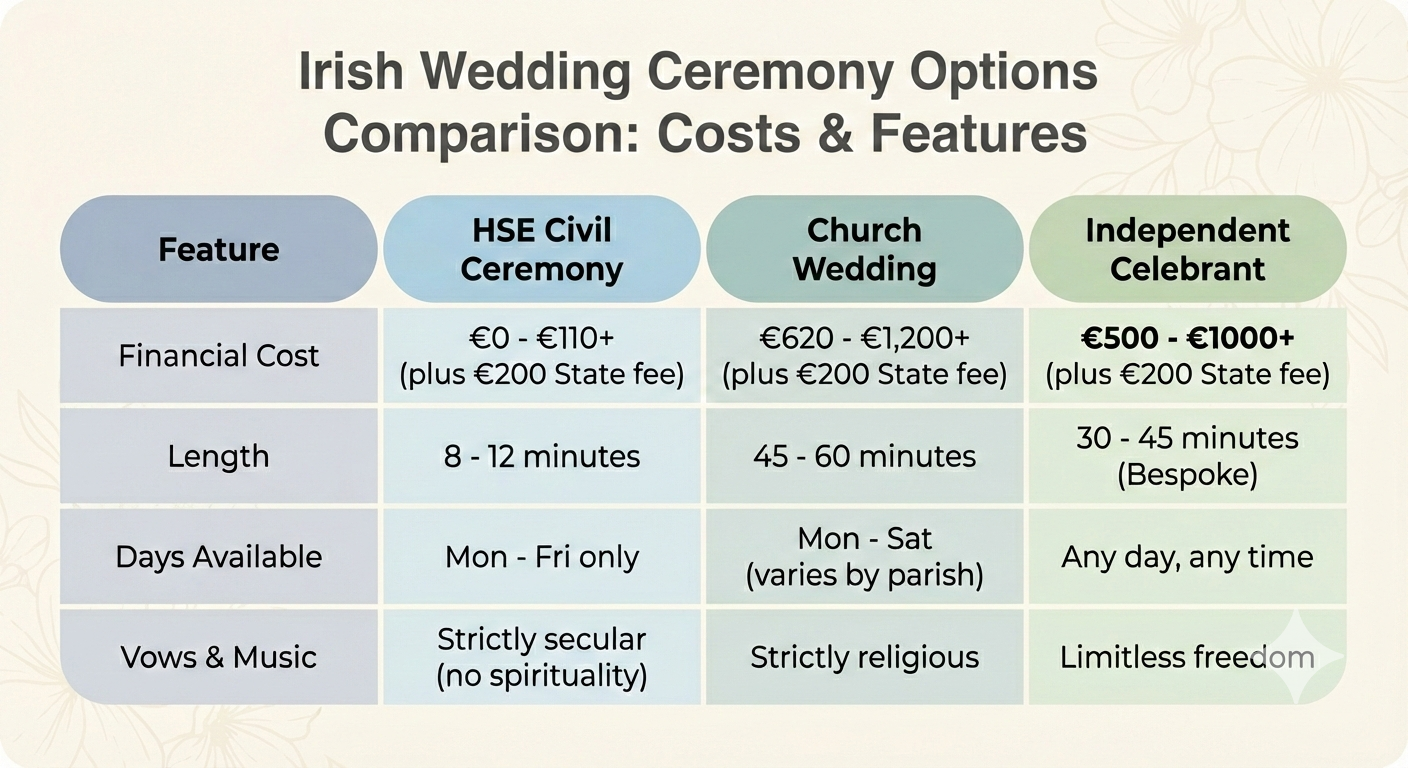
If you choose to get married in the HSE registry office itself, there is no additional fee beyond your €200 notification. If you want an HSE registrar to come to your approved wedding venue, there is an additional fee (typically around €110, plus potential travel expenses).
The Experiential Cost
This is where the true "cost" of the HSE route becomes apparent.
The Schedule: HSE registrars operate during standard government office hours, typically Monday to Friday. If you want a Saturday or Sunday wedding, the HSE is not an option.
The Time Limit: Your ceremony will usually be slotted into a strict 10 to 20 - minute window. It can feel a bit like a conveyor belt, especially during peak wedding season. So ceremonies are very short - 8 to 12 minutes. And you or your witnesses cannot turn up late…!
The Restrictions: Civil ceremonies are strictly secular. You are legally prohibited from having any religious or spiritual references. This means no spiritual poetry, no cultural rituals with religious origins, and no songs that mention the word "angel," "God," or "heaven."
The Verdict: The HSE is brilliant if you simply want the legal paperwork finalized as quickly and cheaply as possible. However, if you want your ceremony to be a romantic, personalized focal point, the restrictive slot will likely leave you wanting more.
2. Church Wedding Fees in Ireland: Debunking the "Cheap" Myth
Many couples default to a Catholic church wedding because it feels familiar and they assume it’s the most cost-effective option since "the church is already there." The reality of the paperwork, mandatory courses, and hidden fees tells a very different story.
The Hidden Financial Costs
If you are travelling to a picturesque church outside your parish, the fees add up incredibly quickly. Here is a realistic breakdown of what a "free" church wedding actually costs in Ireland today:
Church Booking Fee / Donation: €200 - €500+ (Many churches explicitly charge this for administration and maintenance).
Priest’s "Stole Fee" / Donation: €150 - €250.
The Sacristan’s Fee: €50 - €75 (For opening up, cleaning, and assisting).
Mandatory Pre-Marriage Course: €150 - €250 (e.g., through Accord).
Altar Servers: €20 - €50 each.
Winter Heating Costs: Many parishes now include a "Heating and Lighting Fee" during the winter, adding potentially loads of extra €€€€’s.
Total Estimated Cost: €620 - €1,500+
The Experiential Cost
If a traditional Catholic mass deeply aligns with your personal faith, this is a beautiful route to take. However, if you are doing it just to tick a box, the restrictions can feel heavy. You must use the set liturgy, your vows cannot be independently written, and your music choices must be strictly liturgical or classical (your favorite acoustic indie song walking down the aisle will likely be vetoed).
You are also at the mercy of the priest. Many are lovely. And many are let’s say, difficult… Some terribly difficult. In my other career as a wedding photographer, I’ve experienced countless ceremonies that were impacted negatively for the couple and guests by the actions of a priest. This doesn’t just apply to Irish catholic weddings. Same can be said for Church of Ireland weddings.
In comparison as a photographer, I’ve never encountered a difficult independent celebrant in my 15+ years of weddings.
3. Independent Wedding Celebrant: The Bespoke Investment
An independent wedding celebrant gives you the ultimate luxury in wedding planning: absolute freedom.
The Cost of Hiring a Celebrant in Ireland
A professional, independent celebrant in Ireland typically charges between €500 and €1000+, depending on their experience, travel, and the complexity of the ceremony.
While this might look like a larger single line item than a priest's donation, remember what it replaces: no mandatory pre-marriage courses, no potential of an unpleasant priest, and certainly no hidden "heating charges." You know exactly what you are paying upfront.
The Experiential ROI (Return on Investment)
With an independent celebrant, the experience is entirely built around you.
Total Flexibility: You can get married on a Saturday, a Sunday, at midnight, or at sunrise.
Your Rules: Want to include a Celtic handfasting ritual? A shot of whiskey to seal the vows? Your dog as the ring bearer? Involve your kids with a sand pouring ceremony. A celebrant seamlessly weaves all of this together.
Your Story: You aren't squeezing your relationship into a pre-written 10-minute government template. A celebrant spends a good while getting to know you, writing a customised 20 to 40 - minute script that tells the story of how you met and what your future holds.
Your Friend: Your celebrant is your friend on the day. To them, you not just another couple of faces. They have invested time and effort into you, your family members, your ceremony and whatever enhancements you have selected to include.
The Bottom Line: Choosing the Right Ceremony for You
When you look at the real numbers, the "budget" options often end up costing you heavily—either in hidden fees or in the compromise of your vision.
Your ceremony sets the tone for your entire wedding day. It’s the moment you transition from an engaged couple to a married one. Investing in an independent celebrant means investing in a ceremony that feels authentically like you, leaving your guests laughing, crying, and saying, "That was the best ceremony I've ever been to."